


Executive Summary
The UK’s National Health Service is one of the most significant moral and social institutions in modern British life. Yet, in the twenty first century, it faces a crisis of sustainability: funding pressures, demographic change, workforce shortages, and declining public confidence. This short paper combines the moral insights of Adam Smith and the economic critique of Ludwig von Mises then extends them through the lens of the Nolan political cycle to explain how social mood and political stability intersect with healthcare policy. It argues that a renewed NHS social contract that balances moral duty, economic prudence, and political cohesion is essential to preserving both the NHS and the stability of the centre ground of British society.
Context
The NHS’s founding ideal of care based on need, not based on the ability to pay, free at the point of service and accessible to all residents, embodies a moral principle consistent with Adam Smith’s concept of sympathy. However, mounting pressures are threatening that principle as public expectations rise while service performance stagnates. Many taxpayers perceive they are paying more for fewer services, undermining trust in the institution’s fairness. Without a renewed social contract that reinforces transparency, accountability, and shared responsibility, confidence in the NHS and, by extension, in the political centre may erode.
Adam Smith’s Moral Framework
In The Theory of Moral Sentiments, Adam Smith wrote that the foundation of social life is built on sympathy, the human ability to understand and care for others. A just society, he argued, depends on prudence, justice, and benevolence, all guided by an inner sense of fairness, the impartial spectator. In this light, the NHS reflects a moral truth: a society shows its humanity in how it cares for the vulnerable. But Smith also warned that compassion must be guided by prudence. A system that wastes resources fails both morally and economically. I believe that he would therefore support healthcare that is universal yet efficient, accountable, and grounded in both public and personal responsibility.
Mises’s Critique of Bureaucracy
Ludwig von Mises argued that bureaucracies cannot allocate resources efficiently because they lack market prices and feedback signals. They function through rules, hierarchy, and budgets, not profit and loss. While such organisation is necessary for justice or defence, it can hinder innovation and responsiveness in service delivery and importantly resource allocation. Applied to the NHS, I believe that Mises’s analysis would warn against over-centralisation and bureaucratic inertia. I would further argue that if a bureaucratic structure were to remain he would call for managerial autonomy, transparent performance data, and competition of ideas without undermining the moral goal of universality.
Combining the Thinking of Smith and Mises through Modern Governance
Effective governance would provide a bridge between Smith’s moral duty and Mises’s efficiency. Utilising principles of decentralisation, performance measurement, and transparency would allow public institutions to behave with moral purpose while being disciplined by results. In the NHS, this means empowering local trusts, linking funding to outcomes, and engaging patients as partners rather than passive recipients. This model emphasises outcome-driven management, balancing compassion with accountability.
The Renewed Social Contract
Smith’s moral economy and Mises’s efficiency converge on a shared premise: institutions survive when trust, fairness, and responsibility align. A renewed NHS social contract should rest on three principles: universality, accountability, and shared responsibility. Universality affirms that everyone deserves care. Accountability ensures that public money delivers measurable value. Shared responsibility means that patients use services wisely and maintain personal health, while providers deliver care responsibly, efficiently, and ethically. This mutual commitment strengthens both the moral legitimacy and the long-term sustainability of the system.
Political Dynamics and the Social Political Context
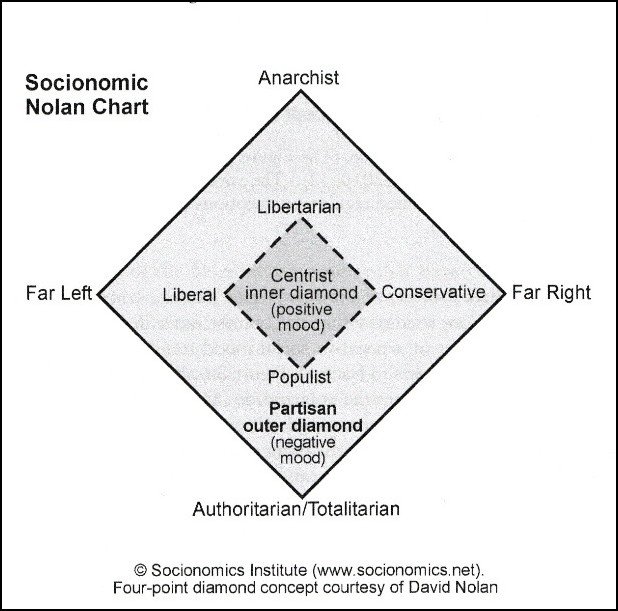
The Nolan political cycle visualises how societies oscillate between centrist consensus and polarised extremes depending on social mood. In times of positive mood, cooperative politics dominates within the “Centrist inner diamond.” When mood turns negative, often during fiscal strain or public disillusionment, societies shift toward the “Partisan outer diamond,” where populist and authoritarian movements emerge. The NHS, as a moral and economic cornerstone, sits at the heart of this dynamic. When the population perceive declining returns, paying more taxes for fewer or lower-quality services, the NHS becomes a lightning rod for discontent. Such erosion of confidence can trigger broader political fragmentation. Without a consciously renewed and communicated NHS social contract to restore trust, the centrist common ground that underpins democratic stability may dissolve, giving way to ideological extremism or even worse civil unrest.
Policy Implications and Mechanisms
To prevent this fragmentation of society and reinforce both institutional and political stability, NHS reform must pursue moral and economic legitimacy simultaneously. Key mechanisms may include:
- Outcome-based funding within stable baseline budgets.
- Decentralised decision-making with transparent public reporting.
- Public engagement in governance through citizen panels and open data.
- Preventive education linking personal health with public minded responsibility.
- Local innovation supported by national learning networks.
These measures strengthen accountability while reaffirming the NHS as a shared civic achievement rather than a partisan battleground. They facilitate risk taking and sharing of successful ideas, rewarding success for all parties of the contract.
Conclusion
I believe that Adam Smith would view the NHS as an embodiment of moral sentiment while Mises would view it as an organisational challenge. Combined, they reveal a deeper truth: moral legitimacy and economic efficiency are inseparable. The NHS’s future depends not only on managerial reform but on political and moral renewal. If policymakers fail to renew the social contract while people continue to pay more for less, the resulting erosion of confidence and trust could destabilise the political centre. Conversely, by uniting moral duty with prudent management, the NHS can remain the cornerstone of both social justice and political stability, preserving the common ground essential for national cohesion.
Alistair Veitch is the Managing Partner of Cairnstone Capital an Investment Firm based in Scotland