


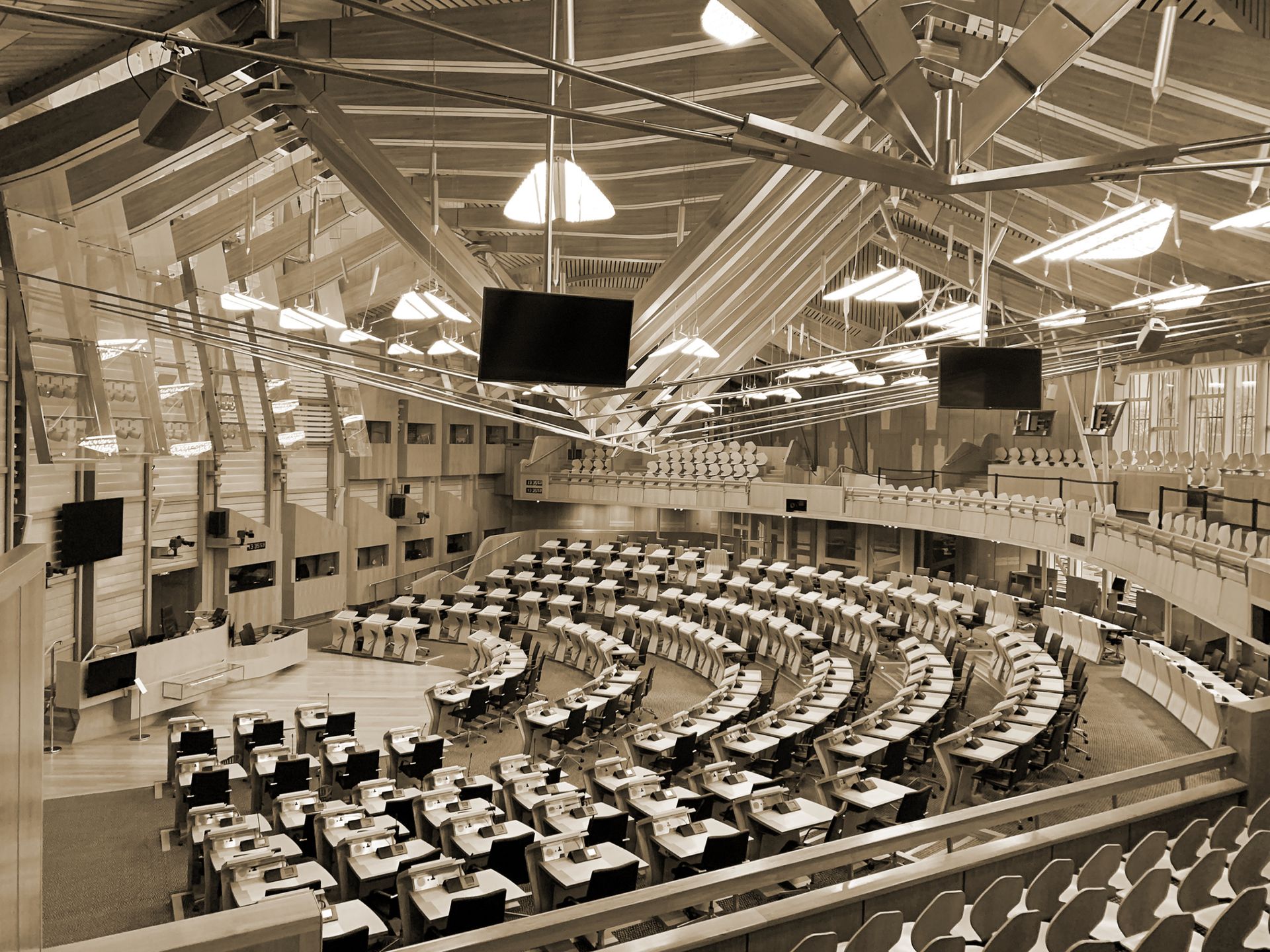
We are proud Scots. We love our nation and want her to reach her full potential, knowing she can always do better. We are blessed to live in a country which has such natural beauty, deep history, and meaningful cultural traditions. For any nation, the primary function of Parliament is to conserve the features that make their country unique and empower people, families and towns to reach their potential. At the heart of these efforts is holding the Government of the day to account. For the most part, it is Government that sets the legislative agenda and oversees the implementation of legislation. Therefore, it is Parliament’s job to scrutinise the proposals of Government; flesh out any weaknesses in Bills; shape proposals so they work in reality. If Parliament is weak, comparatively to Government, then no nation will reach her potential. A strong Parliament is essential for a prosperous nation.
Scotland’s Parliament is not strong. In fact, we would go so far to say that it is institutionally hamstrung through structural design and cultural attitudes. This belief, and our love of Scotland, is what compelled us to write our essay for the Scottish Affairs Journal. We are, however, not the only people talking about the need of Parliamentary Reform at Holyrood. Our party colleagues, Donald Cameron and Murdo Fraser, have written extensively about this. But it is not only Scottish Conservatives. Former SNP minister, Alex Neil, and former Labour MSP and former Presiding Officer, Ken McInstosh, have also written about this; as has former Labour First Minister, Henry McLeish, and Professor James Mitchell in a new book. Whilst the recommendations in each work mentioned are not identical, there are significant overlaps of key themes: committee restructuring, empowering backbenchers, and making Parliament more accessible to the public.
If there is cross-party and academic recognition for parliamentary reform, which there is, then the question becomes: Why is Holyrood not changing? If most recognise that the system is broke, then why is there little attempt to fix it? There is not one definitive source for this scenario, but there are overlapping attitudes. The first of these is complacency. We have a complacent Government who enjoy having a set-up of a strong executive and weak Parliament. We have several complacent MSPs who seem to believe their job is to be photographed with as much third-sector organisations as possible, rather than the actual hard work of holding Government to account. A source of this complacency is the lack of public appetite for the events of the Scottish Parliament and the subsequent lack of parliamentary reporting by the media. Another attitude is control. The Government feels in control due the weak Parliament. Party leaders feel in culture due to a lack of backbench culture. Why would you seek any reform which diminishes your control? The third, and final, attitude is pride which punishes all questioning. Of course, we should inspire for a Parliament which all Scots can be proud of, but there is also a reason why pride is one of the deadly sins. When pride results in out casting for simply suggesting that not everything is perfect, then pride is an obstacle of progress. It is this deadly combination of complacency, control, and pride which is preventing Holyrood from becoming the parliament it can and should be.
Control
Holyrood was conceived as a legislature in which ideas would emerge from the “bottom up.” Its institutional design was intended to disperse power: committees were empowered to draw on their subject-matter expertise, scrutinise legislation robustly, and, crucially, initiate Committee Bills. The absence of any built-in mechanism for single-party dominance was meant to ensure that legislation reaching the Chamber would be the product of negotiation, compromise, and cross-party deliberation. In its early years, between 1999 and 2011, this vision broadly held. Committee Bills remained infrequent, but the institutional culture was more pluralistic, and the executive was structurally required to engage with opposition parties.
The watershed moment came in 2011. With the SNP securing an outright parliamentary majority, the dynamic of governance shifted dramatically. For the first time, a Scottish Government discovered that Holyrood’s institutional architecture makes it unusually vulnerable to executive dominance. Both structurally and culturally, the Parliament’s mechanisms for scrutiny are weak when placed under strain by a confident majority administration. As the experience of several controversial Bills demonstrates, such as Named Persons, Gender Recognition, and Offensive Behaviour at Football, an assertive government can push legislation through Holyrood even when the design or public support for that legislation is questionable. This is not an aberration; it is the rational exploitation of a system whose checks and balances were never built to withstand majority rule.
Holyrood’s structural vulnerabilities are compounded by the legal and bureaucratic environment in which MSPs operate. Members still lack full parliamentary privilege, a deficit that the Salmond inquiry starkly illuminated: MSPs cannot speak freely without risk of legal consequences, and a Parliament that cannot speak freely cannot properly scrutinise. At the same time, the civil service wields disproportionate institutional influence relative to the small, unicameral Chamber. Ministers rotate, but officials endure, drafting legislation, shaping committee evidence, and acting as the default repository of policy knowledge. Committee churn and the rapid turnover of MSPs and staff mean institutional memory is constantly lost, preventing expertise from bedding in and leaving ministers and civil servants with a decisive informational advantage. Without a second chamber and with committees insufficiently empowered, there is no effective check on this bureaucratic dominance. Executive control, reinforced by bureaucratic continuity, legal constraint, and the erosion of institutional memory, thus finds fertile ground in Holyrood’s design.
This political reality suits governments. When executive dominance is achievable, why would any administration, regardless of party, voluntarily expose its agenda to greater scrutiny or empower institutions capable of constraining it? Parliamentary reform requires a majority of MSPs, yet government parties are structurally incentivised to resist changes that would dilute their influence. The result is an institutional paradox: meaningful reform requires the consent of those who benefit from the status quo.
A second locus of control reinforces this dynamic: party leadership. As argued in our essay in the Scottish Affairs Journal, Holyrood’s internal parliamentary procedures have, in practice, strengthened the authority of party leaderships over their MSPs. Apart from members’ business, MSPs must seek permission from party whips, not the Presiding Officer, to speak in debates. This grants party hierarchies significant control over not only who is heard in Parliament but also what is said. An MSP who gains a reputation for independent thinking rather than message discipline is unlikely to be prioritised for parliamentary visibility, and without visibility, electoral viability weakens.
These pressures are compounded by the party-list component of Scotland’s electoral system. While parties require votes to secure list seats, individual MSPs require favourable placement on their party’s list to be re-elected. Securing such placement demands popularity with party leaders and with party members. To remain in favour with party leadership, MSPs must align with the party’s strategic priorities. To remain visible among the membership, MSPs must speak frequently in the Chamber. Both incentives reinforce conformity. The logic is simple: loyalty is rewarded, independence penalised.
Reforms that would strengthen Holyrood’s institutional autonomy, empowering backbenchers, enhancing committee independence, or diluting leadership control, run counter to these incentives. Party leaders have little reason to support reforms that would weaken their authority. MSPs, even those who privately support reform, risk damaging their career prospects by championing it publicly. The consequence is a self-reinforcing cycle: party leaders maintain control because MSPs are incentivised to seek their approval; MSPs seek their approval because leaders control their visibility and advancement.
In such a system, the absence of reform is not a failure of imagination or political will. It is the predictable outcome of a Parliament designed to disperse power but practised in ways that concentrate it, and of political actors who rationally choose to preserve the advantages that concentration affords.
Complacency
Alongside structural control, a deeper cultural complacency permeates Holyrood. The atmosphere is unusually comfortable for an institution that should function as a forum of rigorous scrutiny, intellectual contestation, and demanding public service. Parliamentary life ought to involve engagement with complex legislation, mastery of parliamentary detail, sustained interaction with constituents, businesses, and civic organisations, and, above all, a persistent appetite to hold power to account. Yet across parties, this appetite is too often absent. The prevailing culture discourages the kind of restless vigilance that healthy democratic institutions depend upon.
A central feature of this culture is the emergence of what may be described as “insiders” and “outsiders.” The insider group is defined by conformity, deference, and a reluctance to disturb established hierarchies. In the Chamber, this manifests in opposition MSPs softening their criticism of ministers, often in the misplaced belief that courtesy or restraint will secure goodwill from the Government. The empirical reality shows otherwise: conciliatory behaviour is frequently met not with constructive engagement but with dismissive or partisan responses from ministers. Yet the habit persists. This reluctance to challenge, to probe, or to risk unpopularity functions as an informal protection for those in power, reducing the likelihood of confrontational scrutiny and therefore undermining any meaningful push for parliamentary reform.
The insider culture extends beyond the Chamber. Many third-sector organisations, some heavily reliant on Scottish Government funding, exert disproportionate influence in shaping parliamentary discourse. It is appropriate for interest groups to contribute to policy debates (though they shouldn’t get Government funding); it is not appropriate for parliamentarians to accept their views uncritically or to outsource legislative judgement to them. MSPs should interrogate evidence, weigh competing perspectives, and situate proposals within broader strategic goals. Too often, however, they do not.
A pattern has emerged: organisations receive government funding, develop policy proposals, use their networks to elevate these proposals, and are then invited to committees as “independent” expert, where they predictably advocate for the same policies they have helped design. This circularity blurs the boundary between independent scrutiny and state-sponsored advocacy. It is why we proposed that any organisation receiving public funds should be required to declare this explicitly when providing evidence to a committee.
The existing closeness between government and segments of the third sector reinforces insider behaviour: those who support the Government’s preferred direction are amplified and rewarded, further diminishing incentives from out with for parliamentary independence or reform.
By contrast, those who resist this culture, the outsiders, face tangible consequences. The clearest example is Fergus Ewing, whose opposition to the Deposit Return Scheme stemmed from a detailed examination of the evidence and a willingness to diverge from the official party line. His refusal to adopt the positions advocated by ministers and echoed by influential third-sector groups led to his expulsion from the SNP group. Ewing’s case is instructive: independent thought and principled dissent came at significant personal and political cost. His experience illustrates the risks borne by MSPs who challenge entrenched control. For many, the message is obvious: conformity ensures career stability; dissent invites sanction. This dynamic breeds the complacency that now characterises large parts of the institution.
If Holyrood is to undergo substantial parliamentary reform, more MSPs must be willing to reject the comfort of the insider role and embrace the responsibilities, and risks, of the outsider. Parliamentary reform will not emerge from those who benefit from the system as it stands. It requires a cultural shift in which independence, scrutiny, and intellectual honesty are rewarded rather than penalised. Without such a shift, the Parliament will remain structurally constrained, culturally compliant, and resistant to the reforms necessary for it to function as a truly autonomous check on executive power.
Pride
As we argued in our Scottish Affairs essay, the Scottish Parliament was founded on a defining aspiration: that it would be fundamentally different from Westminster. This aspiration, shaped by the political mood of the late 1990s, carried with it a powerful assumption: that by rejecting Westminster’s practices, Scotland would automatically create a superior model of parliamentary governance. This belief, still held in some quarters today, has proven to be unfounded. Simply inverting Westminster’s procedures has not produced the “world-leading” legislature envisioned at Holyrood’s inception. Yet any suggestion that the Scottish Parliament might learn from Westminster’s strengths is frequently dismissed as an attack on Scotland itself.
This reflex reveals a deeper problem. For a significant number of people, Holyrood has ceased to be viewed primarily as a democratic institution; it has become a symbol of national identity, an emblem of Scotland’s distinctiveness and, for some, its future independence. Under this symbolic framing, criticism of Holyrood is treated not as institutional analysis but as a cultural affront. To question its effectiveness is to “talk Scotland down,” to undermine national pride, or to promote a supposed desire to reinstate Westminster dominance. The rhetoric is often hyperbolic, but its political effect is real: it shuts down public debate.
This defensiveness has serious consequences. When the Parliament becomes a proxy for Scottishness itself, it becomes insulated from scrutiny. Structural weaknesses are minimised or ignored; failings are deflected with the familiar refrain: “But look at Westminster.” This comparison is deployed not as a tool of evaluation but as a shield against parliamentary reform, allowing Holyrood’s shortcomings to persist unchallenged. The result is a culture in which pride inhibits learning, reflection, and institutional improvement.
The problem is exacerbated by both the thinning of the media landscape and the cultural dynamics that insulate Holyrood from scrutiny. Government communications teams now vastly outnumber political reporters, investigative journalism has declined, and ministerial announcements dominate the news cycle. Without sustained media pressure, institutional weaknesses remain largely invisible to the public, allowing complacency to persist unchecked. In such an environment, structural and cultural flaws within the Parliament continue unchallenged, and citizens are deprived of the information necessary to demand meaningful reform.
This deficit of external scrutiny is compounded by a pervasive reluctance, both inside and outside Parliament, to confront inconvenient truths. Fear of being labelled unpatriotic, anti-Scottish, or hostile to devolution encourages self-censorship: criticisms are whispered privately but rarely voiced publicly. While understandable, this reticence is deeply damaging.
A mature democracy requires the capacity to critique its own institutions without collapsing into accusations of disloyalty. Parliamentarians, in particular, have a duty not to protect national myths but to defend the public interest. True patriotism lies not in uncritical reverence for Holyrood, but in demanding that it performs better, speaking candidly about institutional failures, challenging narratives rooted in pride rather than evidence, and advocating reforms that strengthen the Parliament’s capacity to serve the people of Scotland.
Conclusion
Taken together, the dynamics of control, complacency, and pride reveal a Parliament that is no longer operating in accordance with its founding ideals. Holyrood was designed to disperse power, elevate deliberation, and embed scrutiny at the heart of Scottish governance. Yet its practice has drifted substantially from this vision. What has emerged instead is a system in which executive authority is structurally advantaged, party leaderships exercise an unusually tight grip over parliamentary behaviour, and cultural norms discourage dissent, independent thought, and serious challenge.
The result is a legislature increasingly defined by its vulnerabilities: a Parliament where governments can legislate with minimal resistance; where MSPs face strong disincentives to depart from party lines; where committees often lack the autonomy and authority to shape policy; and where civic voices are amplified or muted depending on their proximity to government priorities. These are not isolated flaws but interconnected features that reinforce one another. A compliant political culture strengthens executive dominance; executive dominance sustains complacency; and complacency is protected by a belief that critique is synonymous with disloyalty.
Holyrood’s institutional weaknesses are not the product of bad actors or malicious intent. They are the predictable outcomes of a system whose rules, incentives, and political culture now work against the purposes for which the Parliament was established. But if these trends are predictable, they are also reversible. Institutions can be redesigned. Cultures can be reshaped. Incentives can be realigned. What is required is not nostalgia for a previous era nor resentment toward the present, but a clear-eyed recognition that the Parliament’s current trajectory is unsustainable if Holyrood is to function as an effective democratic check on executive power.
Central to this reform must be a rebuilding of committees on principles of independence and capability. Conveners should be elected by secret ballot of the whole chamber rather than installed by party whips, and their remuneration should reflect ministerial levels to attract the most capable MSPs. Committees themselves should be divided between Bill Committees, tasked with line-by-line scrutiny of Government legislation, and Subject Committees with the authority and space to develop their own committee-led bills. A Backbench Business Committee is also essential to ensure that parliamentary time is allocated according to public interest and cross-party demand, rather than hoarded by party managers.
Equally vital is a higher standard of transparency for those giving evidence to committees. Any organisation receiving public funds should declare that relationship clearly when appearing before Parliament. Scrutiny cannot rely on a closed circle of government-funded bodies validating government policy. Parliament needs independent voices, free of financial dependence on the very ministers they are asked to scrutinise. Only with such independence and openness can committees fulfil their proper role as engines of deliberation, challenge, and legislative innovation.
Procedural reform within the Chamber itself is also critical. Speech lengths should be extended to allow genuine interventions and argument rather than rote recitation, while countdown clocks could help MSPs manage their contributions and encourage meaningful exchange. Question deadlines should be moved closer to delivery so that ministers cannot rehearse answers days in advance. Without spontaneity and the possibility of surprise, scrutiny risks becoming theatre rather than accountability. These relatively straightforward adjustments could immediately strengthen the quality of debate and reinvigorate parliamentary engagement, complementing broader structural reforms.
Scotland deserves a legislature that scrutinises rigorously, debates honestly, and legislates wisely. It deserves committees with genuine autonomy, backbenchers with meaningful influence, and parliamentary procedures that reward independence rather than conformity. It deserves a political culture in which MSPs feel empowered to question, challenge, and dissent without fear of marginalisation. Most importantly, it deserves a Parliament capable of self-reflection, and willing to reform itself accordingly.
The path to such a Parliament will not be easy. Those who benefit from the status quo, governments, party leaderships, and institutional insiders, have little incentive to initiate reform. Yet democratic renewal has rarely come from those in power; it has come from those willing to hold power to account. If Holyrood is to become the Parliament Scotland needs, reform must be demanded by MSPs who refuse to accept complacency; by civic organisations that value independence over access; and by citizens who expect a Parliament worthy of their trust.
The case for parliamentary reform is no longer a matter of preference, it is a matter of democratic necessity. Holyrood must be strengthened if it is to serve Scotland with the integrity, rigour, and ambition that its founders envisioned. The time has come for MSPs, parties, and the public to commit to meaningful institutional renewal.
If we want a Parliament that truly reflects the aspirations of Scotland, we must reform it: boldly, urgently, and without apology.
Stephen Kerr is a Scottish Conservative MSP for Central Scotland and former MP for Stirling. James Bundy is Scottish Conservative councillor for Falkirk North Ward on Falkirk Council.
4 comments
wattie moodie
all i want to say, in my opinion it should just be parties registered in Scotland who are allowed to stand for the Scottish parliament, labour,tory and lib dems are all registered in England and seem to interfere in our business
Angus Tulloch
One easy reform would be to have random parliamentary, rather than the present party block arrangement. For over 100 years, seating in the Icelandic parliament has been managed by lottery at the beginning of each session. Such a system would help remind MSPs that they are elected to serve their country and constituencies, not narrow political party interests. It would also encourage better collegiality.
Elizabeth Russell
An excellent article accurately describing the birth and early years of devolution. Devolution whilst full of aspiration is a unique experiment and consequently has to evolve. Change is the hardest process. If you could summarise the article to accommodate the public short attention span and use it as a slow drip but strong message the public are hungry to listen. They desperately need strong leadership.
John Quinn
Change, that simple word with such depth of meaning, change to what, For better or good and who decides the path of travel?
The article is fulsome in its content and well written and argued but why do I still feel frustrated ?
Perhaps because it misses the next step, change to what, what will be the vision and who has it to carry the population of Sotland forward in the future.
Rewrite the whole agenda or let the current debacle in all political parties continue to bicker and tinker?
Was it mao tse tung who said a “journey of 1000 miles starts with the first step? But Tung forgot to say in which direction!
We’ve had the 1000 miles but not the direction needed and go round in circles like a rudderless ship.
After Swinney who will be the next FM, is there one in Scotland that has a real vision of what my fellow Scots need?
Fear of the future or hope for a miracle , 20 years of devolution has not evolved into a state of forward thinkers has it just been a political experiment that politicians have not grasped the reality of motivating, directing and finally moving the population into a successful economy, well run by people who truly care about our country.
We’ve had independence all along but constrained by poor leadership of limited talent.