A week is a long time in politics. Over 25 years? A lifetime. As the swathes of MSPs retiring from the Scottish Parliament this time around testifies, it is perhaps even ‘a generation’, given the scale of global change we’ve witnessed – take the past decade or so; Austerity, Covid, the (latest) Russian invasion of Ukraine, the conflict in the Middle East, and of course a second Trump Presidency!
As we approach the Scottish Parliament election in May ‘26, just over a quarter of a century since the ‘Dawn of Devolution’ – described by the first First Minister as “a journey not a destination” – now would seem an appropriate time to pause, reflect and consider next steps. And that’s exactly what each of the political parties are doing, driven individually by the political imperative of their next ‘date with democratic destiny’, but with a largely common focus on what matters most.
Scotland’s regional economies.
These are our engines of sustainable growth. It is also here, in these regional economies, where economic and environmental sustainability can be viewed, genuinely, as being ‘two sides of the same coin’ – what we increasingly call the “currency of inclusive growth”.
Of course, we don’t live our lives according to neat lines drawn on administrative maps, and so these ‘functional economic geographies’ are porous, with ‘fuzzy boundaries’.
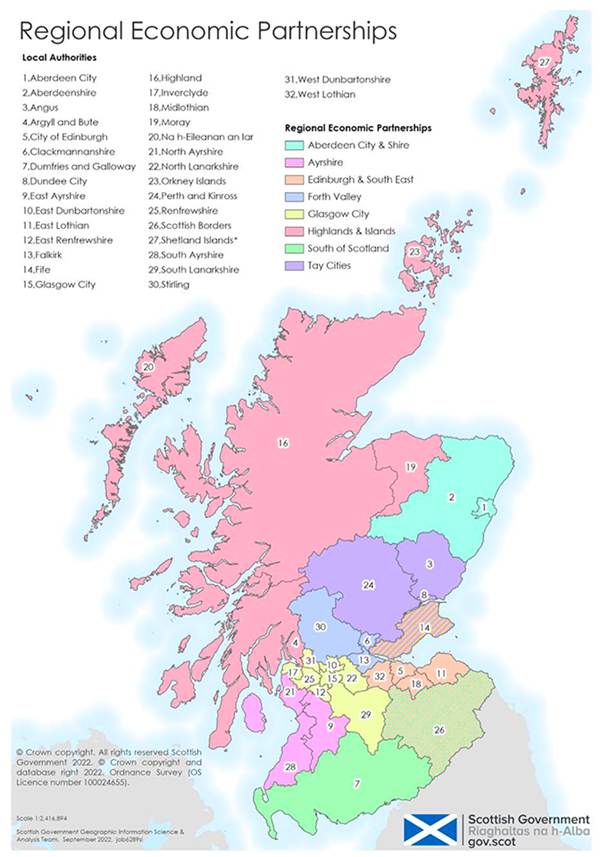
The Kingdom of Fife, for example, sits within the Capital City Region, the Tay Cities Region and that of the Forth Valley. Argyll & Bute straddles a border between the Glasgow’s Metropolitan City Region and the Highlands & Islands, at the other end of which is the uniquely interesting Moray – a case study in ‘equidistant entrepreneurialism’ – that also plays into Aberdeen & the North East.
Elsewhere, Ayrshire’s regional economy has a symbiotic relationship with its City Region neighbour to the North, whilst the South of Scotland is an integral part of the The Borderlands, as well as playing into the City Regions to the North and South of both the Scottish Borders and Dumfries & Galloway. And that’s not to mention its the link over to Northern Ireland, and beyond into the EU.
Messiness is normal.
Scotland’s ‘8 and a bit’ regional economies reflect that reality of how we live, work and play, one which was perhaps most notable during the depths of the Covid crisis, partly driven by diktat but mostly – as can be seen from the continuation of the resultant behavioural changes – now shaped by personal preference. We enjoy a ‘nationally coherent, regionally diverse’ economic system.
As Scotland’s Towns Partnership has been demonstrating with its hugely successful and vibrant “Scotland Loves Local” campaign, this connection of people and place is visceral, and highly valued. Witness the bounce that many of our towns and neighbourhood centres have experienced, in contrast to the more challenging times which our city centres continue to endure, driven (if you’ll forgive the pun) by a radical realignment of transport patterns, including the daily commute.
Each of our regional economies plays its own respective, and relative, role contributing through its own core characteristics to the national picture, one that is continuously evolving. By building upon the strengths of each region, Scotland’s economy can finally tackle the three structural deficits which we first identified in SCDI (now Prosper)’s 2015 Blueprint; “From Fragile to Agile”, namely; poor productivity, low levels of innovation and an anaemic performance of internationalisation. These challenges remain, and now both our governments agree that the route to tackle them is regional.
The policy response to these structural challenges – the National Strategy for Economic Transformation (NSET) – is constructed upon three principal pillars; People (the emerging, post Withers, National Skills Strategy), Place (NPF4 with its ‘infrastructure first approach’) and Connectivity (NTS and STPR2). These three are also now the basis of the UK’s Industrial Strategy, thereby aligning both our governments around ‘the power and purpose of regional devolution’.
This forms a solid basis for collaboration – at the regional, Scottish and UK levels – offering a collective ability to focus on what Scotland’s economy needs, ensuring that appropriate ‘permissions and powers’ are placed at each level. When we return to membership of the EU, as we must given sheer scale of the now widely recognised hit on the UK economy of Brexit, we’ll recognise this as an integral part of that most European of terms, ‘subsidiarity’!
But it’s not all plain sailing. As NSET points out, there are some very tough decisions to be taken reshaping our public services, dealing with decades of fragmentation, as highlighted on a regular basis now by Audit Scotland. We must also face up to the challenges described by the Scottish Fiscal Commission in its starkly clear articulation of the impact of our ‘demographic time-bomb’. Tick tock.
The reassuring thing is that none of this is new.
In order to improve effectiveness, we know how to tackle the inefficiencies of current patterns of provision; whether that’s aligning the supply of school places with the changing (and now mostly declining) patterns of demand for them through school catchment reviews as many local authorities have done, or reshaping health & social care to end expensive bed blocking through partnership centres with shared management and budgets, or integrating our public transport, and active travel, networks to cut congestion and air pollution, as is being planned for the Clyde Metro.
Tough choices, but we know from experience that once decisions are taken, the results kick in surprisingly quickly.
We also know how to improve productivity, raise levels of innovation and boost the international performance of each of our regional economic typologies. Enable our Regional Economic Partnerships, as advocated in The Muscatelli Report, by transferring powers and permissions from centralised national agencies, and let them get on with the job.
This is true for each of the three policy pillars of; People (implement the Enterprise & Skills & the Withers Reviews in full), Place (assign infrastructure budgets and full decision making to the regional level through the next round of CityRegion/ Growth Deals), and Connectivity (fire up the Regional Transport Partnerships whilst aligning them to our functional economic geographies – see the REPs map below.
In terms of governance, the REPs will shape up – perhaps even in different forms in different regions (eg based upon the GCR Cabinet, or a Local Enterprise Partnership or the Opportunity NE model) once they have the statutory underpinning likely, if polling is anywhere near accurate, to be at the heart of next year’s Programme for Government.
So, let’s hope that this shared platform of ambition is enough to bring some ‘sense and stability’ to whatever shape the Scottish Government takes after May, to its relationship with the UK Government – anad how they both empower Scotland’s regional economies.
As I’ve been saying since the ‘end of the last century’;
“It’s the regional economy, stupid!”
(with my usual apologies to James Carville)
Ross Martin is an adviser on regional economies