

Scotland’s public services are facing a productivity crisis, not just a funding crisis. While the 2026/27 Scottish Budget and Spending Review underline the need for efficiency, the route to achieving it is no longer just about cutting costs, it is about releasing capacity.
Across health, education, local government and justice, many of Scotland’s most highly-trained professionals are spending too much of their week on routine administrative tasks such as documentation, record keeping, correspondence and processing rather than the complex, human work that only people can do.
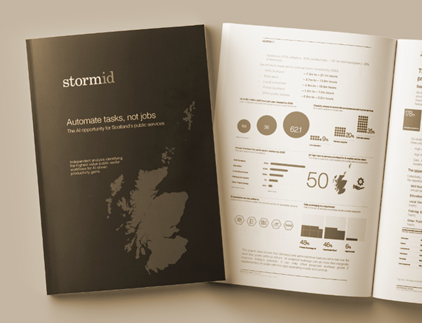
That is why Storm ID has undertaken and published new research in “Automate tasks, not jobs: The AI opportunity for Scotland’s public services”. Our conclusion is straightforward – AI is now mature enough to reduce administrative drag at a meaningful scale and that makes it a practical lever for public service reform not just a futuristic concept that is happening elsewhere.
Capacity release means time back, not just cash savings
Public debate about “efficiency” often focuses narrowly on cash savings, but in public services, the true currency of value is time. Capacity release means returning hours to frontline teams. The goal is not to replace people, but to strip away the administrative drag that causes burnout and backlogs. By automating, the routine would allow, for example, justice professionals to focus on complex casework, healthcare professionals to focus on care, and give teachers more time in the classroom.
62 million hours is the size of the prize
We analysed 50 high-volume Scottish public services where AI-enabled redesign could credibly reduce administrative burden. The potential is huge.
Our modelling suggests that by 2030, AI adoption could release between 16.6 million (conservative) and 62.1 million (optimistic) hours of capacity annually.
To put that in perspective, the moderate scenario (36m hours) represents a 20% release of total capacity across the workflows assessed. Two main sectors stand out in the analysis:
- NHS Scotland: The single largest opportunity lies in clinical documentation. This accounts for 68.2 million baseline hours. Reducing this burden isn’t about automating judgment, it’s about freeing clinicians from data entry so they can spend more time with patients.
- Education: The “always on” administrative workload of planning, resource creation and data entry is competing with pupil time. AI offers a way to reset this balance.
Scale through patterns, not pilots
While public services vary enormously in mission we found that many of their underlying workflows are very similar. Our analysis of the 50 services highlights that a lot of staff time clusters into just a few repeatable patterns, including case management, application processing, decision making and knowledge-intensive documentation.
This insight offers a clear path forward. Scotland does not need 50 bespoke AI tools with 50 separate assurance regimes. The faster and safer route is to build reusable, configurable components that solve these common problems once. By integrating a suite of trusted, shared tools into existing systems we could eliminate duplication of effort and accelerate adoption at scale.
What policymakers need to do next
Turning potential into capacity by 2030 is a leadership agenda as much as a technology one. The paper identifies five key areas of focus:
- Start with high-volume, lower-risk services to demonstrate value quickly and build institutional capability.
- Invest in shared components that can be configured locally, rather than reinvented repeatedly.
- Around half of the services we analysed involve sensitive data (clinical and justice). These require Private AI models running on sovereign infrastructure, not just use of public cloud wrappers from hyperscalers such as AWS and Azure.
- Scaling requires clear accountability, audit trails, testing and monitoring, cyber controls and defined human oversight consistent with Scotland’s commitment to trustworthy and inclusive AI.
- Staff engagement in redesign, training and continuous improvement is essential so that time saved becomes better outcomes, not just absorbed by unmanaged demand. Redesign must be done with the workforce, not to them.
The cost of inaction
Unless we systematically reduce administrative burden, rising demand will outpace capacity no matter how committed the workforce may be.
The message for policymakers is simple. AI is a practical, immediate lever for the productivity step-change Scotland requires. We must choose to govern it well, scale it deliberately and use it to return time to the work that only people can do.

Paul McGinness is Founder and Chair of Storm ID