


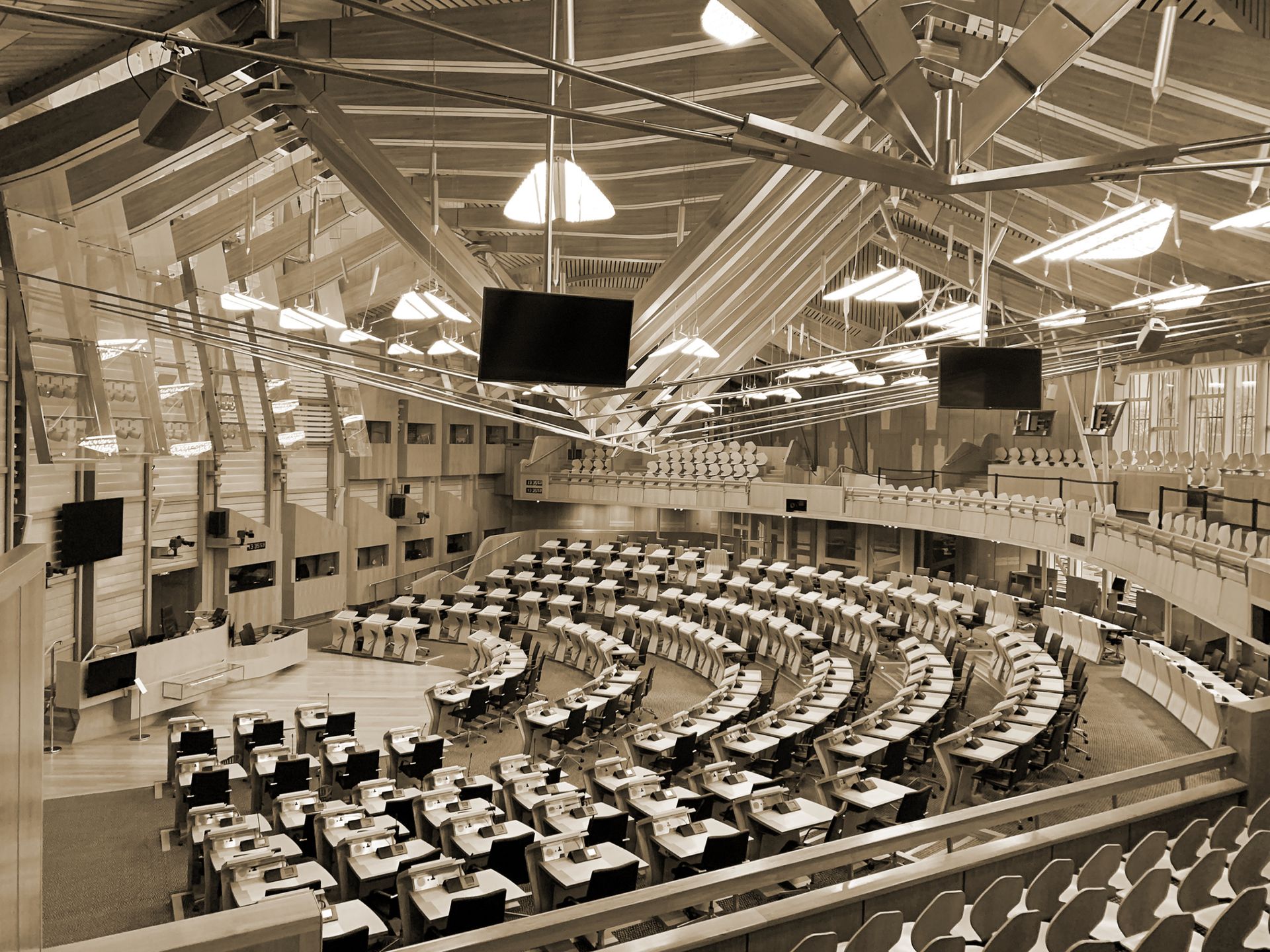
After the dust settles following a national election, attention naturally turns to the composition of the new Parliament. Who are the rising talents? What coalitions and alliances will emerge? Will the new government represent continuity or change?
Amidst these questions, institutional reforms can often pass with little attention. Yet some of the most consequential political decisions are not about legislation or personalities, but about how Parliament itself functions. That is why the reforms announced by the new Presiding Officer of the Scottish Parliament, Kenneth Gibson, deserve serious attention.
For years, Holyrood has suffered from a growing sense of stagnation. Debate has become increasingly scripted, scrutiny increasingly performative, and too much power has accumulated in the hands of party leaderships and government whips. The reforms announced by the Presiding Officer are therefore welcome. They represent a recognition that Holyrood’s culture is not healthy and that parliamentary reform is necessary.
The changes themselves are significant. First Minister’s Questions will now take place twice weekly, with separate sessions for party leaders and backbench MSPs. MSPs will no longer be required to submit FMQs in advance, though questions may still be indicated beforehand to the Presiding Officer. General and portfolio question sessions will be expanded, creating more opportunities for ministerial scrutiny. The threshold for securing a Members’ Business debate has also been reduced from support from three parties to two.
Collectively, these reforms aim to make Holyrood more spontaneous and less scripted. That matters.
Anyone who regularly watches the Scottish Parliament will recognise how stale proceedings have become. Too often, speeches are written in advance, questions are rehearsed, and answers are delivered irrespective of what was asked. The most infamous example came when Nicola Sturgeon answered the wrong question entirely because she had already begun reading from a pre-prepared response before the question had been completed.
That moment became memorable because it revealed a wider truth about Holyrood: much of parliamentary exchange had ceased to be genuine scrutiny and instead become political theatre.
This environment suited government ministers. It allowed difficult scrutiny to be managed and uncomfortable exchanges to be minimised. But it weakened Parliament itself. When governments become too comfortable, scrutiny deteriorates, legislation receives less challenge, and democratic accountability suffers.
Kenneth Gibson deserves credit for recognising this problem. His early reforms suggest a genuine desire to strengthen parliamentary scrutiny and challenge the culture that has developed over the past 25 years of devolution. That is encouraging.
But these reforms must only be the beginning.
The most significant change is the decision to separate FMQs between party leaders and backbenchers. Implicit within this reform is an acknowledgement that Holyrood lacks a strong backbench culture. Giving ordinary MSPs greater opportunity to directly challenge the First Minister is therefore a positive step.
The question, however, is whether MSPs will fully utilise that opportunity.
Some undoubtedly will. There are capable and serious-minded backbenchers across the chamber who genuinely want to scrutinise government effectively. Yet the structural incentives that have weakened scrutiny remain in place.
Government backbenchers will still be tempted to ask rehearsed and flattering questions designed to assist ministers rather than challenge them. Opposition leaders will still be incentivised to prioritise viral social media clips over forensic scrutiny. Modern FMQs often functions less as a parliamentary exercise and more as content production for X, Facebook, and TikTok.
This is one of the central problems with Holyrood’s current political culture. Parliamentary exchanges are increasingly shaped not by persuading Parliament, but by generating clips for supporters online. The result is a chamber dominated by “gotcha” moments, exaggerated outrage, and performative exchanges that rarely illuminate policy failures or improve public understanding.
Splitting leaders’ questions from backbench questions may improve the atmosphere of FMQs, but it does not by itself solve this deeper problem.
Early indications from the first session of backbench First Minister’s Questions on Tuesday 2nd June 2026 suggest that the hoped-for cultural shift may be harder to achieve in practice. The session was, in many respects, disappointing. The atmosphere felt dense, and many of the questions lacked originality. In several cases, it appeared that government backbenchers were working from pre-prepared lines of questioning developed within party structures. If so, that represents a missed opportunity. The purpose of the reform was to liberate backbench scrutiny, not to reproduce managed exchanges in a new format.
Questions were also, in general, too long. Some took the form of mini speeches rather than genuine questions. While context is sometimes necessary, there is a growing tendency for FMQs to become a vehicle for set-piece political messaging rather than inquiry. That risks undermining the purpose of the reform itself.
One particularly striking example came from a new SNP MSP whose question focused on Peter Mandelson, a figure with no direct relevance to the business of the Scottish Parliament. This kind of drift towards Westminster-centric or purely performative questioning illustrates a wider problem: FMQs risks becoming a stage for generalised political commentary rather than focused scrutiny of devolved government. Parliamentary time is a limited resource, and it should be directed towards accountability within Holyrood’s actual remit.
A further limitation was the absence of supplementary questions. Without the ability to follow up, scrutiny risks becoming superficial: issues are raised but not pursued. One possible reform would be to reduce the number of MSPs called, while guaranteeing each MSP who asks a question the right to a supplementary. That would encourage genuine exchanges rather than a sequence of disconnected statements.
Prior to the session, a reflection led by Archbishop Leo Cushley emphasised the importance of listening in public life. That point felt especially relevant. A parliamentary format built around one-off interventions encourages talking rather than dialogue. If Holyrood is to develop a more serious scrutiny culture, it must prioritise exchange over performance.
The expansion of general and portfolio questions is also welcome. More time for questioning ministers should strengthen scrutiny. However, scrutiny is not simply about quantity. The effectiveness of parliamentary accountability depends on asking the right questions, at the right time, with sufficient freedom to pursue emerging issues.
At present, Holyrood’s procedures often undermine this. Some parliamentary questions must be submitted a week in advance. In modern politics, where major developments can occur within hours, this timescale is increasingly absurd. By the time questions are asked, events have often moved on.
The submission deadline for parliamentary questions should therefore be dramatically reduced. Questions should generally require to be submitted no earlier than noon on the previous sitting day. That would allow MSPs to respond to current developments and hold ministers accountable in real time rather than retrospectively.
Similarly, opposition spokespeople should be guaranteed opportunities during portfolio question sessions. If the Cabinet Secretary for Health is answering questions, health spokespeople from across the opposition parties should be guaranteed substantive supplementary questions without prior submission requirements. Effective scrutiny requires genuine engagement, not pre-scripted exchanges.
Urgent Questions must also become more common within the Scottish Parliament. One of the frustrations surrounding Holyrood is how infrequently ministers are compelled to appear before Parliament to answer pressing matters of public concern. If Parliament is to function as a meaningful scrutiny chamber, ministers must regularly be required to account for rapidly developing events.
To improve accountability further, the office of the Presiding Officer should publish all unsuccessful Urgent Question applications. Greater transparency would strengthen confidence in the process and encourage consistent standards across parliamentary sessions.
The reforms to Members’ Business debates are another positive step. Reducing the support threshold from three parties to two should make it easier for debates to reach the chamber, particularly given Scotland’s ideological parliamentary landscape, where smaller parties can otherwise effectively exercise vetoes over certain topics.
Yet even here, deeper structural problems remain unresolved.
Although Members’ Business motions may now require support from only two parties, party leaderships still ultimately control debating time allocation. In practice, this means party whips continue to exercise substantial influence over which debates reach the chamber floor.
This matters because Holyrood’s weak backbench culture is not accidental. It is structural.
With only 129 MSPs, party leaderships naturally exercise tighter control than is possible at Westminster. Political advancement often depends upon loyalty to leadership rather than independence of thought. Cross-party collaboration becomes more difficult, while genuinely independent parliamentary initiatives become rarer.
As a result, parliamentary business can become excessively centralised and overly partisan. Debates are sometimes selected not because they address matters of national importance, but because they offer electoral advantage or assist party messaging strategies.
That is unhealthy for Parliament.
If Holyrood is serious about strengthening scrutiny and improving debate, it requires institutional mechanisms specifically designed to empower backbench MSPs.
One possible solution would be the creation of a dedicated cross-party backbench business committee. Once a Members’ Business motion secured support from MSPs across two parties, responsibility for allocating debating time should pass to this committee rather than remaining under party leadership control.
Such a reform would strengthen parliamentary independence, encourage cross-party engagement, and reduce the ability of party whips to suppress uncomfortable or politically inconvenient debates.
Alongside these structural reforms, there must also be cultural reform.
Questions at FMQs should be confined strictly to devolved matters. If an MSP attempts to ask a question primarily concerning reserved issues, it should be ruled out of order. Holyrood cannot effectively scrutinise devolved government if significant parliamentary time is routinely spent debating matters outside its legislative competence.
Similarly, Parliament must confront the corrosive influence of selective social media clipping. If MSPs or political parties wish to publish parliamentary exchanges online, there should be an expectation that full questions and full answers are shown together rather than selectively edited fragments designed purely for partisan advantage.
This would not eliminate political theatre entirely, but it would help discourage the worst incentives currently shaping parliamentary behaviour.
There must also be a wider recognition amongst MSPs themselves that scrutiny is not solely the responsibility of opposition parties. Government backbenchers are elected members of Parliament first and governing party representatives second. Their constitutional role includes holding ministers accountable, even when politically inconvenient.
That cultural shift is difficult to legislate for, but it is essential if Holyrood is to mature institutionally.
In the Scottish Affairs Journal, Stephen Kerr MSP and I argued that meaningful parliamentary reform requires two changes to happen simultaneously: creating a culture where MSPs outside government understand their primary responsibility is to scrutinise executive power and creating institutional structures that genuinely empower backbench MSPs to do so effectively.
Some of the reforms we proposed have now been partially reflected in Kenneth Gibson’s early changes. That should be welcomed. It suggests the new Presiding Officer understands the scale of the challenge facing Holyrood.
But much more remains to be done.
The Scottish Parliament was created with ambitious hopes of being more open, collaborative, and accountable than Westminster. In some respects, it succeeded. In others, it gradually developed many of the same weaknesses it was originally designed to avoid: excessive party control, managerial politics, weak scrutiny, and increasingly scripted parliamentary exchanges.
Kenneth Gibson has made an encouraging start. Unlike many institutional reform discussions, these changes are tangible and substantive. They demonstrate a willingness to challenge existing practices rather than simply defend them.
But truly becoming a reforming Presiding Officer will require confronting the deeper political culture that has emerged over 25 years of devolution.
That means being willing to challenge governments that have become too comfortable with weak scrutiny. It means demanding higher standards from MSPs themselves. And it means recognising that parliamentary reform is not ultimately about procedure alone. It is about restoring Holyrood’s confidence as a serious democratic institution capable of holding power to account.
The early signs are encouraging. But if Holyrood is genuinely to become the robust and independent Parliament Scotland was promised, this reform agenda must go much further.
James Bundy is a Scottish Conservative Councillor and writer on Scottish Parliamentary Reform. James also leads a campaign on improving emergency stroke care in Scotland.